Where's A Good Samaritan When You Need One?

"And because lawlessness abounds, the love of many will grow cold."--Jesus, Matt 24:12
Well, Jesus was right. The hearts of many have grown cold.
Just look and see. I couldn't believe this.

"And because lawlessness abounds, the love of many will grow cold."--Jesus, Matt 24:12
Well, Jesus was right. The hearts of many have grown cold.
Just look and see. I couldn't believe this.
"In a variety of voices, this group of friends is attempting to sing a song a together."--Tony Jones on The Emerging Church.


"No written law has ever been more binding than unwritten custom supported by popular opinion."--Carrie Chapman Catt, suffragist.
 Since the labels "liberal" and "feminist" come with a lot of baggage and Finney himself hated stereotypes, I won't pigeonhole him to these descriptions, but I will say he dabbled in activities and efforts associated with "liberal" and "feminist" goals more than most people realize. This is a great synopsis from The Rebel God blog on the christian leader Charles Finney, a figure immortalized in many conservative-evangelical camps, who ironically advocated women's rights by admitting women into his college, allowing them to speak publicly at revival meetings, etc. This aided in spurring on the early feminist movement, which had a very spiritual foundation. Finney was also dedicated to more "liberal" causes and intertwined personal faith WITH social action. Very interesting read!

I am a political person. The role of politics is an important one. However, it has severe limitations, as does government (I'm sure that made my conservative friends happy). Regardless of who becomes President in 2008, real long-term change comes from the bottom up. There's good news and bad news to this reality. The bad news is that placing all of our hopes in a single leader to implement long lasting change in our country and around the world is unrealistic. The good news is that the people at the bottom (you and me), everyday ordinary people can be freed from banking all our national visions on the lesser of two evils. We can make the difference. We can make change--even in the muck and mire of partisan politics. Jim Wallis pinpoints this exciting opportunity in the following article.
"Peace and friendship with all mankind is our wisest policy, and I wish we may be permitted to pursue it. "--Thomas Jefferson
Read the previous post to read the first part of this article.
 Two men, whose families have suffered greatly at the hands of religion-motivated violence, healing wounds by coming together....forgiveness is a beautiful thing.
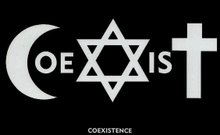
"The only alternative to coexistence is codestruction."
--Jawaharlal Nehru
I am always amazed when Christians get their panties in knot when other Christians seek to be peacemakers and bridge builders to people from whom we differ. Isolating ourselves from all those with whom we differ breeds arrogance, misconceptions, insensitivity, the tendency to villify, animosity, and frankly, ignorance. Coexistence is the foreground to effective communication between conflicting views and communication is necessary for true conversion. For a refresher on my views on coexistence, see "Blessed Are The Peacemakers For They Shall be Called...Liberal Hippies?"
Even though I should see these things coming, it still shocks me.
Read Brian McLaren's response to Focus on The Family's criticism of Christians finding common ground with Muslims to better reach out to them.
Shouldn't we find points of common ground with those of different faiths and work from there?
 The following article, "The Story We Tell Ourselves," written by Brian Mclaren appeared in last month's issue of Sojourners/Call To Renewal Magazine. It struck a chord with me by reminding that the lives we live, the choices we make, the realities we accept, the action we take, or the indifference we cultivate, are all framed by our perspective of the world, the story in which we find ourselves. As Christians, what are our perspectives shaped by? Do we rely on God's story of the kind of kingdom He yearns to be established here on earth? Are our perspectives tainted by the world's stories of political ideologies, nationalism, power, fear, violence, greed, practicality, despair, distrust, etc.?
 "Hypocrisy: prejudice with a halo."
--Ambrose Bierce
There's been a lot of buzz this week about Pat Robertson, host of the 700 Club, deciding to endorse Rudy Giuliani for President. Now, I like Giuliani and thought he was a superb mayor of NYC and efficiently cleaned up the city. But their is an entire slue of reasons of why I will not be voting for him for President, but alas, that will have to be the topic of another post.
"We have just enough religion to make us hate, but not enough to make us love one another."
--Jonathon Swift. 
This week, the wacko-fundamentalist Westboro Baptist Church, pastored by Fred Phelps, lost in court and was ordered to pay up $11 Million dollars to the father of a fallen soldier, who was killed in Iraq. Members of the Topeka Kansas based congregation have traveled around the country for decades protesting concerts, political gatherings, parades, and even other churches. In the last few years they began to get quite a bit of media attention because they started protesting at military funerals. That's right, while parents and loved ones grieved over and buried their dead children, The Westboro church bombarded them with signs and shouts of:
"Thank God For Dead Soldiers"
"God Hates You"
"God Hates Fags"
"God Hates Fag Enablers"
"Thank God for 9/11"
"Don't Worship The Dead"
"God Hates America"
"God Killed Your Children,"
"Thank God for IEDs"
Members of Westboro Baptist identify themselves as 5-point Calvinists (extreme belief in predestination), who "preach," not so people will repent and convert, but to rub in the unstoppable coming judgments of God upon all those who God hates and has destined for hell...
The reasoning, and I use that word loosely, behind these cruel protests is that America is too tolerant of gay people (because we don't stone them) and therefore, if you serve in America's military, God hates you and will judge you by killing you. According to these fanatics, all the victims of 9/11, Katrina, school shootings, and the war all deserve it, and we should be rejoicing in their deaths. So, much for the good news of the gospel, eh? This is without a doubt the most reprehensible and disgusting perversion of the gospel I have ever seen.
And then justice comes in....
One of the fathers who had to endure Westboro's vile protests while burying his son who was killed in Iraq sued them and was awarded 11 million dollars! Obviously, he'll never see all the money, but it will cripple Westboro Baptist and strip them of their resources to conduct their hate-demonstrations around the country. 42 states have passed laws setting a certain number of feet away protests must be held from funeral services as a result of such insensitive, cruel protests. I'm all for free speech, even ugly free speech, but infringing on other people's rights (such as interrupting funeral services) while exercising free speech is unconstitutional and should be restricted.
But alas, overwhelming outcry against the methods and teachings of Westboro Baptist Church do not phase its congregation whatsoever. They use the old "The world hated Jesus, so they will hate us, too" line. So, in their minds, THEY are the victims and the persecuted ones! Not to be crass, but that whole thing about the world hating Christians because they hated Jesus doesn't count if you are being an inhumane douchebag. :) People don't like douchebags either, and that has nothing to do with Jesus.
Below is a segment from 20/20 about the Westboro Baptist Church. The sickest part is the children that are being indoctrinated with this filth.
The video below is Shirley Phelps, daughter of Fred Phelps and avid protester, on Fox News' Hannity and Colmes. For those of you who know me, you are aware that I have HUGE issues with Sean Hannity, but in this case I wanted to give him (and Colmes) a big kiss for denouncing and exposing this FRINGE movement for what it really is....
Shirley Phelps on Hannity and Colmes
The following is an interesting column from Sojourner's Magazine, written by J. Christopher LaTondresse, who works in the inner-city streets of D.C., about the underlying factors that contribute to the out of control abortion rate in our country.
Tackling Abortion: The Cruel Connection (by J. Christopher LaTondresse)
There is a cruel link between poverty, race, and abortion in America. Unfortunately, many pro-life advocates fail to meaningfully address this connection.Aside from age (the abortion rate is highest among girls under the age of 15) the most predictable indicator of whether or not a woman will have an abortion is her income level and ethnic background.Before Roe vs. Wade decriminalized the procedure, many American women still had abortions, though the procedure was radically unequal in its accessibility and application. Those with available resources traveled abroad for safe procedures while low-income women relied on dangerous illegal clinics operating in the poorest neighborhoods in America.As someone who lives and works in such neighborhoods in Washington D.C., I can tell you that simply making something illegal does not keep it from happening if there is a serious demand for it – as evidenced by the rampant drug, weapons, and prostitution trades still plaguing these communities.I strongly believe in the sanctity of human life from conception until natural death; that all human beings are created in the image of God and are therefore of immeasurable worth. However, I also believe that we should spend more energy advocating policies that might actually reduce the abortion rate and spend less time challenging a judicial precedent unlikely to be overturned.
This is especially true if criminalizing the procedure does little to reduce the abortion rate and actually puts more lives at risk, as a recent study and the personal experiences of those who have lived and worked in these district neighborhoods much longer than I have would suggest.Tackling poverty, providing healthcare for all low-income women and children (especially for prenatal and postnatal care), reducing teen pregnancy by promoting abstinence and making contraceptives widely available, and increasing the child tax credit for low-income mothers and families—all represent solutions that, as part of an integrated approach, would curb unwanted pregnancies and reduce the number of abortions.
Americans on both sides of the argument have been trapped in an endless debate. Continuing liberal and conservative politicking has failed to meaningfully address the issue. Meanwhile, the abortion rate essentially stays the same.
This tired exercise continued as the entire lineup of Republican presidential hopefuls addressed the Values Voter Summit in Washington D.C., an event co-sponsored by the Family Research Council Action, Focus on the Family Action, and other conservative Christian organizations.
In a room filled with the would-be kingmakers of evangelical politics, the candidates touched on issues ranging from gay marriage to the future of federalism, but the single issue gaining the most traction with the crowd was clear. Candidates hoping to do well with this audience had to address abortion—specifically, offering their best plan to eliminate it once and for all. I was disappointed to hear the same old polarizing terms that have gotten us nowhere in the past 30 years.
Many people agree that the estimated 3,500 abortions taking place in America every day are unfitting for any caring society. Significantly reducing the number of abortions in this country—ideally to zero—should be an urgent moral priority for those of us who take the sanctity of life seriously.As we move into the 2008 presidential election cycle, let's quit demonizing each other and get to work meaningfully addressing the cruel connections underlying America's heartbreaking abortion statistics. The most important debate is not between "pro-life" and "pro-choice," but between those who will continue to be demagogues on this issue and those who will choose to pragmatically work together to save unborn lives.
J. Christopher LaTondresse is the special assistant to the CEO at Sojourners. For the most recent U.S. abortion statistics, visit: U.S. Center for Disease Control.
 This is an article from Sojourners, written by Editor and Chief Jim Wallis, about the values Christians hold dear and fight for in the political and social realms. Wallis puts forth a wonderfully constructive vision for how the Body of Christ needs to operate TOGETHER to live out God's Kingdom here on earth...even amidst the messy business of politics.
If those we could agree on these basic principles, we could re-shape American politics—and, with God's help, we might change some of the big things that politics has been unable to.
As for politics in an election year, the Catholic Bishops have some good advice for us. They counsel Christians to be:
Because, above all, (back to where we started) we are called to be faithful to the principles of the kingdom of God.
The following article is an open letter from Sojourners Magazine written by Tony Campolo in response to Stan Guthrie's criticism of Red Letter Christians, who take the words and teachings of Jesus exceedingly seriously. I find it bizarre (and yet sadly predictable) that when Christians start reiterating Jesus' message that is marked with radical sacrificial love, they are immediately accused of being "liberal" by the religious right. It is as if the religious right believes that all they have to do to discount other Christians who do not ascribe to their political ideology is utter that magic, dirty word: liberal and that will automatically dismiss whatever points Red Letter Christians are trying to make.
Tuesday, October 09, 2007
Stan Guthrie's Red Letter Blues (by Tony Campolo)
In response to Stan Guthrie's article in the October 2007 Christianity Today, "When Red Is Blue: Why I Am Not A Red Letter Christian," Tony Campolo wrote the following open letter as a response.
Dear Stan,
I have to say, "You got us right!" You said:
Though I own several Bibles with the words of Christ in red, I've always found the concept a bit iffy. After all, we evangelicals believe in the plenary, or full, inspiration of Scripture, don't we? Setting off Jesus' sayings this way seems to imply that they are more holy than what is printed in ordinary black ink. ...[I]f all Scripture is God-breathed, then in principle Jesus' inscripturated statements are no more God's word to us than are those from Peter, Paul, and Mary - or Ezekiel.
While we, like you, have a very high view of the inspiration of Scripture and believe the Bible was divinely inspired, you are correct in accusing Red Letter Christians of giving the words of Jesus priority over all other passages of Scripture. What is more, we believe that you really cannot rightly interpret the rest of the Bible without first understanding who Jesus is, what he did, and what he said.
Likewise, we believe the morality in the red letters of Jesus transcends that found in the black letters set down in the Pentateuch, and I'm surprised you don't agree. After all, Stan, didn't Jesus himself make this same point in the Sermon on the Mount? Don't you think his red-letter words about loving our enemies and doing good to those who hurt us represent a higher morality than the "eye for an eye and a tooth for a tooth" kind of justice that we find in the Hebrew Testament? Is it really so hard to accept that, as God incarnate, Jesus set forth the highest law in the Bible, and therefore that law is more important than the Kosher dietary regulations we find in Leviticus and Deuteronomy?
You got us RLCs right again when you suggested we were anti-war, pro-environment, and deeply committed to ending poverty primarily because we believe Jesus is anti-war, pro-environment, and deeply committed to ending poverty. The only mistake you made was to imply that thinking this way - or trying to influence our government according to these values - makes us the Religious Left!
Unfortunately, the platform of Red Letter Christians always seems to come out of the wash blue, just as some other "nonpartisan" Christian groups consistently align with the Republicans.
That you think asking questions such as, "Do the candidates' budget and tax policies reward the rich or show compassion for poor families?," or "Do the candidates' policies protect the creation or serve corporate interests that damage it?," is partisan saddens us. We believe these are the questions that every Christian should be asking, no matter which political party or candidate has the better answers at a given time in history.
The following article appeared earlier this week in Christianity Today. It deals with the different interpretations of biblically permissible divorce. I found this article to be in depth and fascinating in its findings. What are your thoughts on the topic?
"A divorce is like an amputation: you survive it, but there is less of you."--Margaret Atwood
What God Has Joined
What does the Bible really teach about divorce?
David Instone-Brewer
I was being interviewed for what would be my first church pastorate, and I was nervous and unsure what to expect. The twelve deacons sat in a row in front of me and took turns asking questions, which I answered as clearly as I could. All went smoothly until they posed this question: "What is your position on divorce and remarriage? Would you remarry a divorcée or divorced man?"
I didn't know if this was a trick question or an honest one. There might have been a deep-seated pastoral need behind it, or it might have been a test of my orthodoxy. Either way, I didn't think I could summarize my view in one sentence; when I thought about it further, I couldn't decide exactly what my view was. I gave a deliberately vague reply.
"Every case should be judged on its own merits." It worked; I got the job. But I made a mental note to study the subject of divorce, and to do it quickly.
It's a good thing I did. As it turned out, I was surrounded by people who needed answers to questions raised by divorce and remarriage. My Baptist church was located near an Anglican congregation and two Catholic churches. Divorced men and women from these congregations came asking if we would conduct their weddings, having been denied in their local churches. Then I found that some of my deacons had been divorced and remarried. Should I throw them out of church leadership? If I did, I would lose people I considered some of the most spiritual in the church, people with exemplary Christian homes and marriages.What Does the Bible Say?
The New Testament presents a problem in understanding both what the text says about divorce and its pastoral implications. Jesus appears to say that divorce is allowed only if adultery has occurred: "Whoever divorces a wife, except for sexual indecency, and remarries, commits adultery" (Matt. 19:9). However, this has been interpreted in many different ways. Most say that Jesus allows divorce only for adultery. But some argue that Jesus originally didn't allow even that. Only in Matthew does he offer an out from marriage: "except for sexual indecency." Beyond what Jesus says, Paul also allows divorce. He permits it for abandonment by a nonbeliever (1 Cor. 7:12-15). Many theologians add this as a second ground for divorce.
Yet some pastors have found this teaching difficult to accept, because it seems so impractical—even cruel in certain situations. It suggests there can be no divorce for physical or emotional abuse, and Paul even seems to forbid separation (1 Cor. 7:10).
As a result, some Christians quietly ignore this seemingly "impractical" biblical teaching or find ways around it. For example, they suggest that when Jesus talked about "sexual immorality," perhaps he included other things like abuse. Or when Paul talked about abandonment by a nonbeliever, perhaps he included any behavior that is not supportive of the marriage or abandonment by anyone who is acting like a nonbeliever. Many have welcomed such stretching of Scripture because they couldn't accept what they believed the text apparently said.
But does the literal text mean what we think it does? While doing doctoral studies at Cambridge, I likely read every surviving writing of the rabbis of Jesus' time. I "got inside their heads" enough to begin to understand them. When I began working as a pastor and was confronted almost immediately with divorced men and women who wanted to remarry, my first response was to re-read the Bible. I'd read the biblical texts on divorce many times in the past, but I found something strange as I did so again. They now said something I hadn't heard before I read the rabbis!'Any Cause' Divorce
The texts hadn't changed, but my knowledge of the language and culture in which they were written had. I was now reading them like a first-century Jew would have read them, and this time those confusing passages made more sense. My book, Divorce and Remarriage in the Church (InterVarsity Press), is a summary of several academic papers and books I began writing with this new understanding of what Jesus taught.
One of my most dramatic findings concerns a question the Pharisees asked Jesus: "Is it lawful to divorce a wife for any cause?" (Matt. 19:3). This question reminded me that a few decades before Jesus, some rabbis (the Hillelites) had invented a new form of divorce called the "any cause" divorce. By the time of Jesus, this "any cause" divorce had become so popular that almost no one relied on the literal Old Testament grounds for divorce.
The "any cause" divorce was invented from a single word in Deuteronomy 24:1. Moses allowed divorce for "a cause of immorality," or, more literally, "a thing of nakedness." Most Jews recognized that this unusual phrase was talking about adultery. But the Hillelite rabbis wondered why Moses had added the word "thing" or "cause" when he only needed to use the word "immorality." They decided this extra word implied another ground for divorce—divorce for "a cause." They argued that anything, including a burnt meal or wrinkles not there when you married your wife, could be a cause! The text, they said, taught that divorce was allowed both for adultery and for "any cause."
Another group of rabbis (the Shammaites) disagreed with this interpretation. They said Moses' words were a single phrase that referred to no type of divorce "except immorality"—and therefore the new "any cause" divorces were invalid. These opposing views were well known to all first-century Jews. And the Pharisees wanted to know where Jesus stood. "Is it lawful to divorce your wife for any cause?" they asked. In other words: "Is it lawful for us to use the 'any cause' divorce?"
When Jesus answered with a resounding no, he wasn't condemning "divorce for any cause," but rather the newly invented "any cause" divorce. Jesus agreed firmly with the second group that the phrase didn't mean divorce was allowable for "immorality" and for "any cause," but that Deutermonomy 24:1 referred to no type of divorce "except immorality."
This was a shocking statement for the crowd and for the disciples. It meant they couldn't get a divorce whenever they wanted it—there had to be a lawful cause. It also meant that virtually every divorced man or women was not really divorced, because most of them had "any cause" divorces. Luke and Matthew summarized the whole debate in one sentence: Any divorced person who remarried was committing adultery (Matt. 5:32; Luke 16:18), because they were still married. The fact that they said "any divorced person" instead of "virtually all divorced people" is typical Jewish hyperbole—like Mark saying that "everyone" in Jerusalem came to be baptized by John (Mark 1:5). It may not be obvious to us, but their first readers understood clearly what they meant.
Within a few decades, however, no one understood these terms any more. Language often changes quickly (as I found out when my children first heard the Flintstones sing about "a gay old time"). The early church, and even Jewish rabbis, forgot what the "any cause" divorce was, because soon after the days of Jesus, it became the only type of divorce on offer. It was simply called divorce. This meant that when Jesus condemned "divorce for 'any cause,' " later generations thought he meant "divorce for any cause."Reaffirming marriage
Now that we know what Jesus did reject, we can also see what he didn't reject. He wasn't rejecting the Old Testament—he was rejecting a faulty Jewish interpretation of the Old Testament. He defended the true meaning of Deuteronomy 24:1. And there is one other surprising thing he didn't reject: Jesus didn't reject the other ground for divorce in the Old Testament, which all Jews accepted.
Although the church forgot the other cause for divorce, every Jew in Jesus' day knew about Exodus 21:10-11, which allowed divorce for neglect. Before rabbis introduced the "any cause" divorce, this was probably the most common type. Exodus says that everyone, even a slave wife, had three rights within marriage—the rights to food, clothing, and love. If these were neglected, the wronged spouse had the right to seek freedom from that marriage. Even women could, and did, get divorces for neglect—though the man still had to write out the divorce certificate. Rabbis said he had to do it voluntarily, so if he resisted, the courts had him beaten till he volunteered!
These three rights became the basis of Jewish marriage vows—we find them listed in marriage certificates discovered near the Dead Sea. In later Jewish and Christian marriages, the language became more formal, such as "love, honor, and keep." These vows, together with a vow of sexual faithfulness, have always been the basis for marriage. Thus, the vows we make when we marry correspond directly to the biblical grounds for divorce.
The three provisions of food, clothing, and love were understood literally by the Jews. The wife had to cook and sew, while the husband provided food and materials, or money. They both had to provide the emotional support of marital love, though they could abstain from sex for short periods. Paul taught the same thing. He said that married couples owed each other love (1 Cor. 7:3-5) and material support (1 Cor. 7:33-34). He didn't say that neglect of these rights was the basis of divorce because he didn't need to—it was stated on the marriage certificate. Anyone who was neglected, in terms of emotional support or physical support, could legally claim a divorce.
Divorce for neglect included divorce for abuse, because this was extreme neglect. There was no question about that end of the spectrum of neglect, but what about the other end? What about abandonment, which was merely a kind of passive neglect? This was an uncertain matter, so Paul deals with it. He says to all believers that they may not abandon their partners, and if they have done so, they should return (1 Cor. 7:10-11). In the case of someone who is abandoned by an unbeliever—someone who won't obey the command to return—he says that the abandoned person is "no longer bound."
Anyone in first-century Palestine reading this phrase would think immediately of the wording at the end of all Jewish, and most Roman, divorce certificates: "You are free to marry anyone you wish."
Putting all this together gives us a clear and consistent set of rules for divorce and remarriage. Divorce is only allowed for a limited number of grounds that are found in the Old Testament and affirmed in the
New Testament:
Adultery (in Deuteronomy 24:1, affirmed by Jesus in Matthew 19)
Emotional and physical neglect (in Exodus 21:10-11, affirmed by Paul in 1 Corinthians 7)
Abandonment and abuse (included in neglect, as affirmed in 1 Corinthians 7)
Jewish couples listed these biblical grounds for divorce in their marriage vows. We reiterate them as love, honor, and keep and be faithful to each other. When these vows were broken, it threatened to break up the marriage. As in any broken contract, the wronged party had the right to say, "I forgive you; let's carry on," or, "I can't go on, because this marriage is broken."
Therefore, while divorce should never happen, God allows it (and subsequent remarriage) when your partner breaks the marriage vows.
Reading the Bible and ancient Jewish documents side-by-side helped me understand much more of the Bible's teaching about divorce and marriage, not all of which I can summarize here. Dusty scraps of parchment rescued from synagogue rubbish rooms, desert caves, and neglected scholarly collections shone fresh light on the New Testament. Theologians who have long felt that divorce should be allowed for abuse and abandonment may be vindicated. And, more importantly, victims of broken marriages can see that God's law is both practical and loving.
 The following is part of a interview between writer Mishka Assayas and Bono on the subject of God and faith. I like this article, one, because it's about Bono, and two, because he articulutes the the matters of faith in such artistic terms that reveal deeper truths.
I came across this pithy, yet insightful article written by Anglican Bishop Nicholas T. Wright about the role of environmentalism within the Church and the illogical beliefs that too often lead to its dismissal
God's Power Does Not Excuse Human Despoiling
By Nicholas T. Wright
It all depends what your ‘faith’ is. If you believe that the present world of space, time and matter is basically trash, from which we are supposed to be rescued, then who cares?
But if, with Jews and Christians, your ‘faith’ is in a good creator God who has promised to set the world right at last, dealing with its corruption and decay and setting it free from all that to become even more gloriously what it already really is, then of course you will cherish and celebrate the natural world and care for it in all kinds of ways.
Put it like this (what follows is based on Romans 8.18-26, one of the central passages in one of the central Christian texts of all time). If I said, well, I find it difficult to struggle against sin – but one day God will save me and make me totally his, so why bother in the present? – if I said something like that, every pastor worth their salt would tell me that what God intends to do with me in the future must be anticipated, as best I can in the power of the Spirit, by me in the present.
Now, Paul declares that God will set the whole creation free from its slavery to corruption, and will do so under the glorious rule of his redeemed people. If we say ‘Well, that’ll be fine when it comes, but for the moment there’s no point bothering to do anything about it ourselves’, we stand rebuked in just the same way. You wouldn’t say of the person you love best in all the world, ‘Well, one day we’ll be married and I can be kind to him/her then, I needn’t bother for the moment.’ In the same way, to say ‘Well, God will do whatever he wants with this world eventually, but for the moment I can continue to pump carbon emissions and other harmful gases into its atmosphere,’ is simply illogical.
By the way, it is deeply shocking to us in the UK to discover that some American Christian leaders are being forbidden by their denominations to speak on this topic at all. The day when business interests dictate to the church what preachers may and may not discover in God’s word is the day when idolatry has taken over.
 The foolishness of the cross (1 Corithians 1:18) is a concept my flesh constantly wrestles with. It's an ironic statement really, revealing more about humanity's foolishness than God's. His wisdom so supersedes ours that the best way it can be explained to us is as "foolishness." It's a concept that calls for radical sacrifice, radical grace, radical vulnerability, and the radical theology of the Sermon on the Mount. The foolishness of the cross consumes all the micro and macro issues of our time: family, marriage, community, poverty, charity, justice, abortion, war, environment, capital punishment, economic ethics, nationalism, imperialism, capitalism, politics, government, church, prayer, personal faith and relationship with God and each other....oh how the list goes on. And all of this, for the believer, must fall at the foot of the cross and at the mercy of its foolishness. The following article that appeared in Sojourners Magazine is about how the foolishness of the cross takes shape in the body of Christ that is on a pilgrimage through this world singing "Thy Kingdom, Thy Will be Done, ON EARTH as it is in Heaven."
The Foolishness of the Cross
A reflection on the cost of discipleship.
By Joe Roos
In the gospel of Mark, Jesus speaks of the cross and ties it to the meaning of discipleship: "If any want to be my followers, let them deny themselves and take up their cross and follow me" (Mark 8:34).
Think for a moment what the cross meant for those who were listening to Jesus and for those who were reading Mark's gospel some 30 years later. Ched Myers puts it this way: "The cross in Mark's day was neither religious icon nor metaphor for personal anguish or humility. It had only one meaning: that terrible form of capital punishment reserved by imperial Rome for political dissenters." Myers goes on: "The cross was a common sight in the revolutionary Palestine of Mark's time; in this recruiting call, the disciple is invited to reckon with the consequences facing those who dare to challenge the hegemony of imperial Rome."
With this ominous invitation, the cost of discipleship got much, much bigger. Embracing Jesus means embracing that cross. Mark doesn't say it, but I suspect that after these words, the crowds around Jesus got smaller.
Paul takes up the theme of the cross in his first letter to the church at Corinth: "For the message about the cross is foolishness to those who are perishing, but to us who are being saved it is the power of God" (1 Corinthians 1:18). Taking up the cross and following Jesus not only entails great cost, it is also viewed by the world as an utterly foolish thing to do.
I attended some of the first meetings held at Sojourners out of which the organization Witness for Peace was formed in 1983. Witness' first office was in the same building as Sojourners. Today, Witness for Peace is a grassroots organization of people who work for changes in U.S. policy and corporate practices in order to support peace, justice, and sustainable economies throughout the Americas. But at its birth more than 20 years ago, its singular founding purpose was to literally stand between the guns of the U.S.-supported contras and the Nicaraguan peasants at whom the guns were pointed. Two people from Sojourners were part of the first Witness for Peace team that went to Jalapa, Nicaragua, along the border with Honduras, where the contras were encamped.
Initial U.S. press coverage of Witness was not very positive. To most journalists, what Witness was doing made no sense. After the first team went to Jalapa, I remember a political cartoon that ran in the Los Angeles Times. The cartoon caricatured people standing along the border in front of contra guns, holding a sign that said, "Witness for Peace." The caption read, "Witless for Peace." When I first saw it, I laughed out loud. I loved it. The cartoonist, without knowing it, had hit upon a fundamental truth of the gospel, exactly as 1 Corinthians says: "The message about the cross is foolishness to those who are perishing, but to us who are being saved it is the power of God." To stand in the way of bullets like that, to risk getting killed over something not directly affecting you, seems like one of the craziest, most foolish things anyone could do. Witless indeed!
RIGHT-WING TALK SHOW host Rush Limbaugh doesn't get it either. In November 2005, four members of the Christian Peacemaker Teams in Iraq were abducted. Like Witness for Peace, Christian Peacemaker Teams are committed to reducing violence by "getting in the way."
Limbaugh's response to news of the abduction was more crude and cruel than the LA Times cartoonist's response to Witness' presence in Nicaragua. He first called it a publicity stunt, but then said if the kidnapping was real, "I like it. I like any time a bunch of leftist feel-good hand-wringers are shown reality." Unreal, crazy, witless, foolish. Standing up to this system of violence may have made the hostages fools and outcasts to some people in the world, but for those who believe in the power of the gospel of peace, it makes sense. The foolishness of the cross is far more real than Rush Limbaugh's version of reality.
There is something inherently paradoxical about the cross. William Stringfellow, in A Simplicity of Faith, stresses that at the heart of the gospel is a "sense of absurdity—an instinct for paradox—a conviction that truth is never bland but lurks in contradiction." To lose your life is to save it. Unless a grain of wheat dies, it can not bring life. To take up the cross is to embrace the power of God. It doesn't make sense; it's foolish—unless you see it from the eyes of faith, from the converted heart. For believers, it is the very power that transforms lives.
Shortly after describing the foolishness of the cross in verse 18 of 1 Corinthians, Paul goes on to quote from the end of Isaiah 29:14. Verses 13 and 14 in Isaiah are more compelling together, and in their entirety:
The Lord God said: Because these people draw near to me with their mouths and honor me with their lips, while their hearts are far from me, and their worship of me is a human commandment learned by rote; so I will again do amazing things with this people, shocking and amazing. The wisdom of their wise shall perish, and the discernment of their discerning shall be hidden.
When following God becomes reduced to following commandments by rote, be ready for God to shock.
Søren Kierkegaard, the great Danish theologian, addresses this point beautifully. "Christianity," he writes, "has taken a giant stride into the absurd. Remove from Christianity its ability to shock and it is altogether destroyed. It then becomes a tiny superficial thing, capable neither of inflicting deep wounds nor of healing them. It's when the absurd starts to sound reasonable that we should begin to worry." He goes on to name a few of Christianity's shocking, absurd assertions: "Blessed are the meek; thou shalt not kill; love your enemies; go, sell all you have and give to the poor."
Even embedded in the Ten Commandments is the absurd, the foolish, the paradoxical. The Ten Commandments don't begin with "Here are ten commandments, learn them by rote," or "Here are ten commandments, obey them." Instead, they begin with a sweeping announcement of freedom: "I am the Lord your God, who brought you out of the land of Egypt, out of the house of slavery" (Exodus 20:2). We will probably always think of the declarations that follow as the Ten Commandments. But we could, and probably should, think of them as invitations to God's liberation. Because the Lord is your God, you are free to not need any other gods. You are free from the tyranny of lifeless idols. You are free to rest on the Sabbath. You are free to enjoy your parents as long as they live. You are set free from murder, stealing, and covetousness as ways to establish yourself in the land.
But that's not how we think of the Ten Commandments. When the late Kurt Vonnegut was interviewed on National Public Radio about debate on placing the Ten Commandments in courthouses and the like, he responded by saying: "Why the Ten Commandments? I haven't heard any of these people talk about putting the beatitudes up [on the walls of government buildings]." He continued, "'Blessed are the merciful' in a courtroom? 'Blessed are the peacemakers' in the Pentagon? Give me a break! Not exactly the stuff of Donald Rumsfeld or Dick Cheney."
IF I'M HONEST with myself—perhaps if we are all honest with ourselves—there are ways in which we, each in our own way, resist the foolishness of the cross. The cross, Paul says, seems like foolishness to the part of us that is attached to the world, the part of us that is perishing. The cross is God's foolishness and is wiser than our wisdom. The cross is God's weakness and is stronger than our strength. Yet to the part of us that is inculcated with the assumptions and values of our culture, the cross doesn't make sense. Rarely do we choose to be foolish or weak.
Will Willimon has asked some good questions about this foolishness of the cross. What kind of sense does it make to worship a God who, instead of rescuing us out of trouble, rescues us by entering into the trouble with us? A God who, instead of helping us to avoid pain, heals us from our pain by entering the depths of our pain with us? A God who, instead of fixing things for us, addresses them by becoming weak with us in our weakness?
But this is the foolishness of the cross. All of us know pain and grief and disappointment in our lives. Our human wisdom wants a God who will heal us and make us feel better. The foolishness of the cross is a God who enters into our pain and bears our pain with us. To the part of us that is human and perishing, this is incomprehensible and we want something more. But to the part of us that is being saved, it is the very power of God.
And even more foolishly, this very same God expects us to do the same with each other: to enter into each other's pain, to bear each other's burdens and those of the world around us. To the world, that is an utterly foolish way to live, but to those who embrace the cross, who take up their cross and follow Jesus, and who are ready to lose their lives to save their lives, it is the only way to live. It is the power of God within us.
Each of us bears the responsibility, daily, of taking the cross more and more upon our selves, losing ourselves and finding ourselves in the process.
If we want to take Jesus seriously, if we want to go deeper in our discipleship, we must follow in the way of God's foolishness. That's where God calls us to be.
As Frederick Buechner writes: "In terms of human wisdom, Jesus was a perfect fool. And if you think you can follow him without making something like the same kind of fool of yourself, you are laboring not under the cross, but a delusion."
 The men serving in SONrise Missions are committing themselves to preaching the gospel AND bettering the quality of life for the people in North Uganda. It's a beautiful endeavor for beautiful people who have far too long lived under the debris of war, disease, poverty, hunger, and tyranny.
This is a link to a full article about them and how you, if you feel so inclined, can support them. :)
http://ems.gmnews.com/news/2007/0627/Front_page/030.html